

About Bats
€0
There have always been myths about bats.
- Free delivery for purchases over 60€ with DHL Parcel Connect
- Delivery within 3-5 working days
- 14 day return policy
- Customer services open weekdays 8:30-17:00 | +46 (0)431 76800 | info@wildlifegarden.se
- 20 years' expertise in designing, producing and delivering artisanal homeware.
- Maximum age:40 years
- Latin name:Chiroptera
Description
Bats
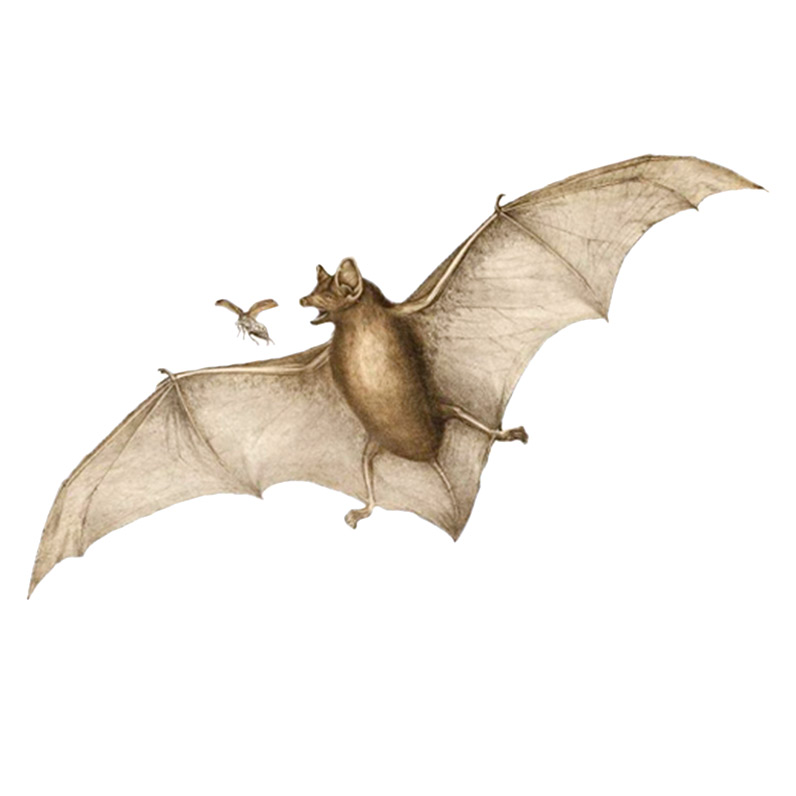
There have always been myths about bats. Many people associate them with horror films and bloodsucking vampires while others are fascinated by their ability to fly and navigate. Bats actually make up one quarter of the approximately 4000 mammal species on earth and live in almost all environments apart from the polar regions, which are too cold.Bats are normally divided into two main groups: microbats and megabats, the last of which do not exist in Europe. All the different species that exist in Sweden live on insects while in other countries there are bats that live on fruit, nectar, fish, frogs and even blood. But only three of the world’s 1100 species are vampire bats and they have only been spotted in South and Central America.
Where do bats thrive?
Many people associate bats with caves, but it is just as common to find them over open landscapes, although not too open as the animal would risk being discovered by enemies.Bats prefer to fly around bushes and trees as it is easier to navigate there and there are plenty of insects. They are voracious mosquito eaters and a female can eat up to 5000 mosquitoes in just one night.
Bats can often be seen flying close to street lamps in the evenings, on the lookout for moths attracted to the light. During the summer they can often be found under bridges and in church spires, nesting boxes and attics.
A year in the life of a bat
The climate has a huge impact on the life of our Nordic bats. During the autumn, the males look for females to mate with. They then start looking for dark, damp places with a temperature of 0-5 degrees where they can hibernate between October and March, when food is in short supply. During hibernation, each bat normally loses one third to a quarter of its body weight.Like migratory birds, some bats like to move south during the winter. Some fly long distances while others fly just a few kilometres. Bats conceive in the spring and the females gather in a maternity roost to have their babies. Most females do not have more than one baby a year, but bats can live to a ripe old age. In fact, it is not uncommon for them to have a lifespan of 30-40 years.
A bat’s senses
Bats have a number of well-developed senses. They navigate using echolocation, which means that they send out sound waves and then find their way by interpreting the echo. Since these sound waves are very high pitched they are extremely short. This means that because bats cannot see us until they are very near, they sometimes fly uncomfortably close by.Bats can also distinguish extremely low frequencies, which allows them to locate insects that they can then catch.
Many people believe that bats are blind, but that is not true. Since echolocation works best at short range, bats use their sight when flying longer distances, such as to and from feeding places or when migrating.
Bat species
The most common Nordic bat species are the Brown Long-Eared Bat, the Northern Bat, the Common Noctule, the Particoloured Bat, Daubenton’s Bat, Pygmy Pipistrelle, Brandt’s Bat and the Whiskered Bat.Bats are protected animals
Bats are an important part of biological diversity but they have been declining in numbers in recent years. Six of our bat species are endangered, partly as a result of the drainage of lakes and watercourses. All Swedish species are therefore protected and may not be killed, captured or moved without the specific permission of the County Administrative Board.Why install a bat box?
There are many advantages to installing a bat box. One of them is that you are providing the bats with a home. Several bat species like to live in hollow trees, but, with so few of them around, a box is a good alternative. It is good to install several boxes in one area since bats most bats live in colonies and it also means that they can move if they are threatened or disturbed. Another advantage is that they won’t need to come into your house and build a nest in the attic. All they need is a gap of one centimetre to get in.The box should be placed three to four metres above ground level with a clear view and free passage around the opening. It is important to make sure that there aren’t any branches close to the box. Ideally, it should be placed facing south, so that the sun heats it up, but not somewhere that gets too much direct sunlight.