

Barn Swallow
€0
Barn swallows return to their old haunts year after year. The birds will find their old nests and last years brood can often breed next to their parents.
- Free delivery for purchases over 60€ with DHL Parcel Connect
- Delivery within 3-5 working days
- 14 day return policy
- Customer services open weekdays 8:30-17:00 | +46 (0)431 76800 | info@wildlifegarden.se
- 20 years' expertise in designing, producing and delivering artisanal homeware.
- Maximum age:11 years
- Eggs and clutches:Incubation 11 - 18 days. 5 eggs, often 2 - 3 clutches.
- Latin name:Hirundo rustica
Description
Barn swallows return to their old haunts year after year. The birds will find their old nests and last years brood can often breed next to their parents. Even in the wintertime, barn swallows will return to the same areas. A branded barn swallow was seen on the same TV antenna two winters in a row in a South African village. Ever since the Stone Age it has followed humans, and today there are few species that are as dependent on humans and their settlement as the barn swallow.
Bird School
Appearance
A swallow with a long tail and a completely dark, somewhat blue-sparkling back. The forehead and throat are dark red and underneath it is white.Similar bird
This is the stereotype swallow with long, thin tail feathers. The house martin has a white belly and no long tail feathers.Sounds and song
The flight call is a short tweet, whereas the song is a mellow twittering concluded with a short rattling.| Song | Warning sound |
Food and bird tables
Eats insects caught in flight.The nest and hollows
The barn swallow is the bird which has come to be the most dependent on human settlement, since it prefers to place its nest on the insides of barns or garages. From time to time one can even find nests under bridges. The barn swallow forms its nest as an open bowl of mud which has been reinforced with pieces of plants. On the inside it is lined with feathers.Distribution
 Summer Summer Resident Resident Winter Winter | 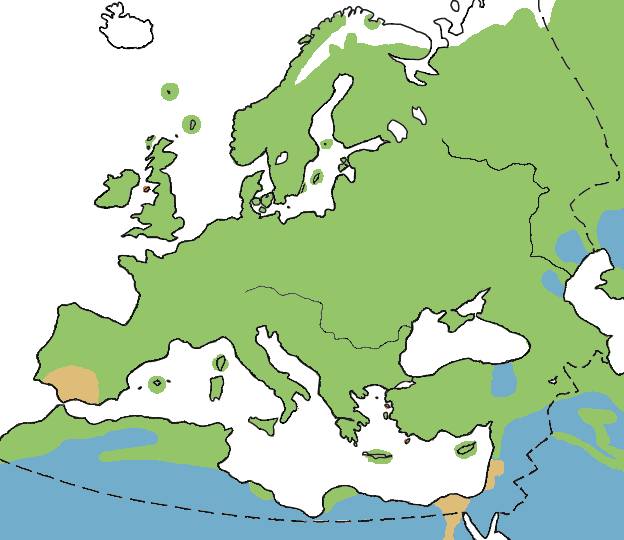 |
Bird School