
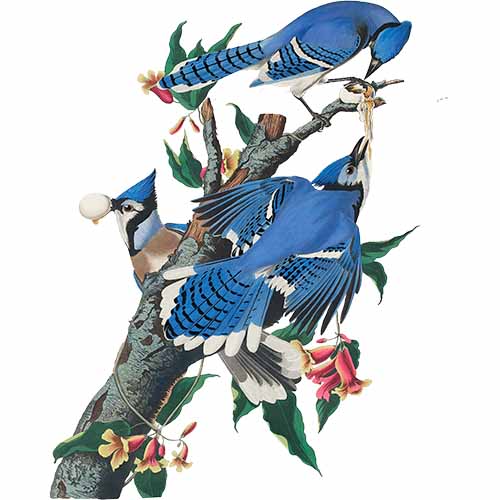
Blue Jay
€0
Native to North America, the blue jay is a bird most people recognise by its brilliant blue colour. It likes to stay close to people or in sparse pine forests. Like other corvids, it is known for its intelligence and for keeping its family grouped together.
- Free delivery for purchases over 60€ with DHL Parcel Connect
- Delivery within 3-5 working days
- 14 day return policy
- Customer services open weekdays 8:30-17:00 | +46 (0)431 76800 | info@wildlifegarden.se
- 20 years' expertise in designing, producing and delivering artisanal homeware.
- PopulationA common bird with an estimated population of 17 million.
- Maximum age:Usually around 8-10 years, but the oldest recorded being 26.
- Eggs and clutches:2-7 eggs in a clutch.
- Latin name:Cyanocitta cristata
Description
Native to North America, the blue jay is a bird most people recognise by its brilliant blue colour. It likes to stay close to people or in sparse pine forests. Like other corvids, it is known for its intelligence and for keeping its family grouped together.
Appearance
Clear blue top, with a black collar contrasting with the white belly. The blue head crest gives it its characteristic profile.Similar birds
There are several bluebirds of similar size in the same family in the United States, but the blue jay is the only one that has both contrasting white fields and a tuft on its head.Sounds and song
Shrill, short sounds, but also a slightly hoarse, whispery babble with great variety. The blue jay can mimic other birds and even other animals and humans.| Song | Contact Call |
Food
The Blue jay is omnivorous and does not shy away from raiding other birds' nests for eggs and young, but most of its diet consists of seeds and nuts. When feeding them, nuts and sunflower seeds are recommended, preferably from a table or platform.Nest
The nest is built using twigs and roots at the base, with moss, grass or mud as a lining. The nest is found high up in the coarser branches of deciduous trees or pines.Distribution
North America, where during the year, they move to both North and South.
 Summer Summer Resident Resident Winter Winter | 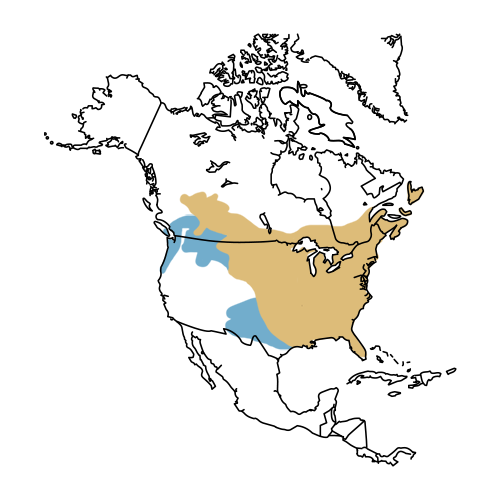 |