
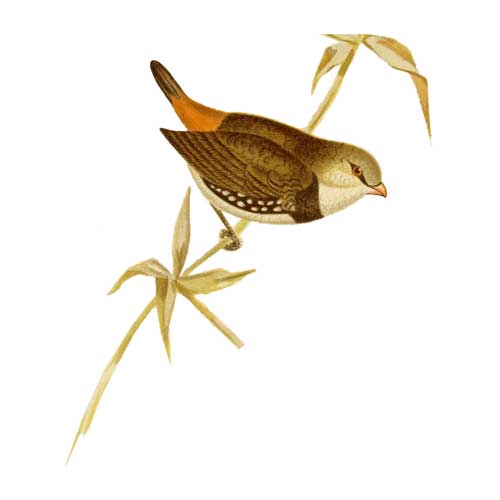
Diamond Firetail
- Free delivery for purchases over 60€ with DHL Parcel Connect
- Delivery within 3-5 working days
- 14 day return policy
- Customer services open weekdays 8:30-17:00 | +46 (0)431 76800 | info@wildlifegarden.se
- 20 years' expertise in designing, producing and delivering artisanal homeware.
- PopulationEstimates range from 100,000 to 200,000 individuals, but the species is declining rapidly and is threatened by the agricultural landscape.
- Maximum age:5–7 years.
- Eggs and clutches:4–9 in two clutches.
- Latin name:Stagonopleura guttata
Description
Description
One of the largest Australian finches with characteristic white spots on a black background on the sides and bright red bill and tail, visible in flight. Their beautiful appearance has made them popular caged birds, but they are difficult to breed in captivity. In the wild, they live in large flocks.
Appearance
In addition to spots on the side and a red beak and tail, the diamond firetail has a strong black collar on a white breast and an olive green back. 10–13 centimeters long. The female is similar to the male, but slightly smaller.
Similar birds
An Australian relative, the red-browed finch, has similar coloring and markings, but lacks the white dots on the side.
Sounds and songs
One or two-syllable curl. Even a longer whistling stanza, broken up by shouts.
Diet
Most of its food consists of seeds it finds on the ground, but it can also eat insects and caterpillars.
Nest
The nest is built of straw and grass, often in thorny bushes. To protect its own nest, the diamond firetail will often settle inside abandoned large birds of prey nests.
Distribution
An Australian bird found in the south-east of the country.
 Summer Summer Resident Resident Winter Winter | 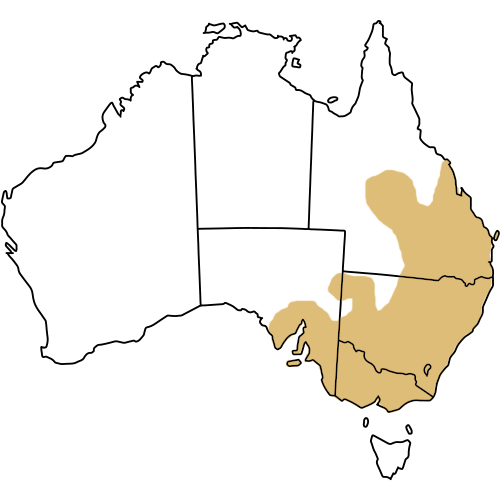 |