
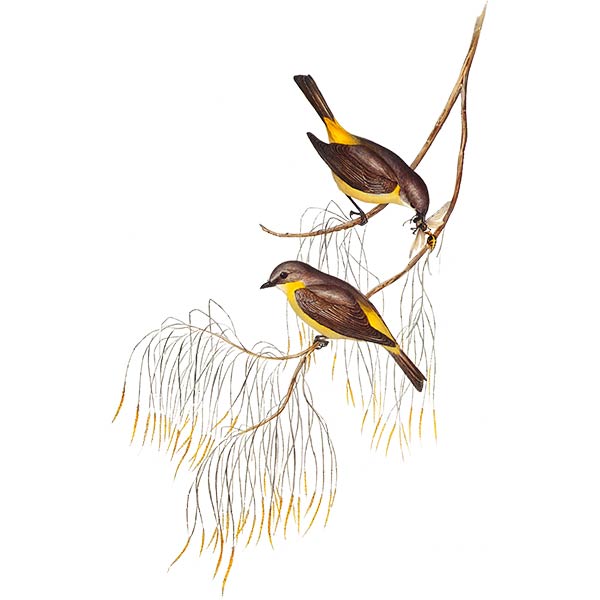
Eastern yellow robin
- Free delivery for purchases over 60€ with DHL Parcel Connect
- Delivery within 3-5 working days
- 14 day return policy
- Customer services open weekdays 8:30-17:00 | +46 (0)431 76800 | info@wildlifegarden.se
- 20 years' expertise in designing, producing and delivering artisanal homeware.
- PopulationA common bird with an increasing population.
- Maximum age:14 years.
- Eggs and clutches:1-3 eggs in up to 3 clutches.
- Latin name:Eopsaltria australis
Description
Description
The yellow robin is a common and typical bird of the eastern and south-eastern parts of Australia. It likes to stay in small groups near people, and its song is easily recognisable. It is said to be the first bird heard in the morning.
Appearance
Bright yellow belly, chin, and silver-grey back and head distinguish the yellow-tailed chin. 15–16 centimetres long.
Similar bird
It has a close relative in Australia's southwest, the western yellow robin, but the latter is only yellow on the belly while the chin is grey.
Sounds and songs
The song consists of repeated melodic chirp-chirp with some swaying and sometimes a chirping verse. The call is repeated short tut-tut-tut-tut.
Diet
Its diet consists primarily of insects of many kinds, but it also enjoys eating seeds and breadcrumbs in the vicinity of humans.
Nest
The female builds the nest, which is a bowl of moss, bark, grass, and fine twigs held together by spider webs on the outside. It is placed in a shady branch, clearing some distance above the ground.
Geographic range
All eastern and south-eastern parts of Australia.
 Summer Summer Resident Resident Winter Winter | 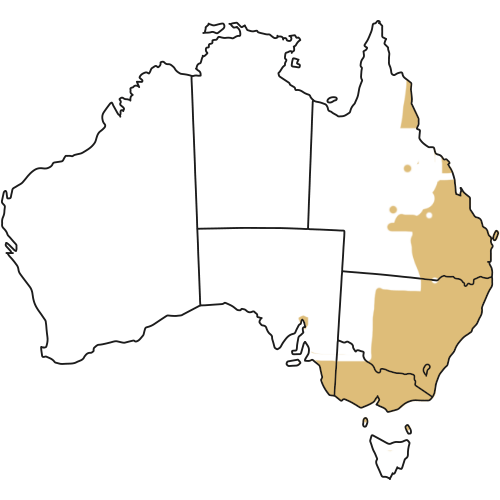 |