
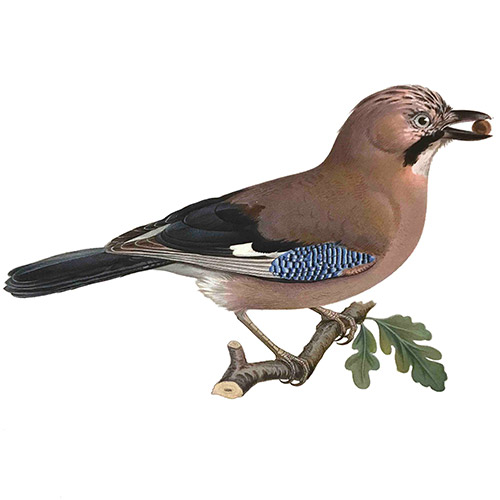
Eurasian Jay
- Free delivery for purchases over 60€ with DHL Parcel Connect
- Delivery within 3-5 working days
- 14 day return policy
- Customer services open weekdays 8:30-17:00 | +46 (0)431 76800 | info@wildlifegarden.se
- 20 years' expertise in designing, producing and delivering artisanal homeware.
- Population The Eurasian jay is not under threat and has a population between 30 and 65 million across Europe and Asia.
- Maximum age:16 years
- Eggs and clutches:3-6 eggs in a clutch
- Latin name:Garrulus glandarius
Description
Description
The white rump glows as it flies among the trees and the jarring scream reveals it. When the Eurasian jay sits still, you can admire the great variety of its plumage—the beige-pink velvety body, fine blue-black wing feathers and thin black stripes on its white head. Like many crows, it is considered intelligent.
Appearance
It is a fairly large bird, with a body of around 35 centimetres and a strong black beak with a black moustache. In flight, it is a bit wobbly. It thrives in many types of forests and parks.
Similar bird
In sound, it can be confused with other crows, but not the appearance.
Sounds and songs
Short, loud and jarring screams distinguish the Eurasian jay, sometimes dense, sometimes at small intervals.
Diet
The Eurasian jay has a varied diet of fruits, berries, nuts and insects. But it also eats small rodents and can raid bird nests for eggs and young. In the fall, it fills tree hollows with oak and beech leaves for the winter.
Nest
The male and female help construct the nest from small branches, grass, and moss. They position the nest in a branch cluster near the tree trunk.
Geographic range
The Eurasian jay is found throughout Europe and in scattered locations in Asia and the Pacific coast.
 Summer Summer Resident Resident Winter Winter | 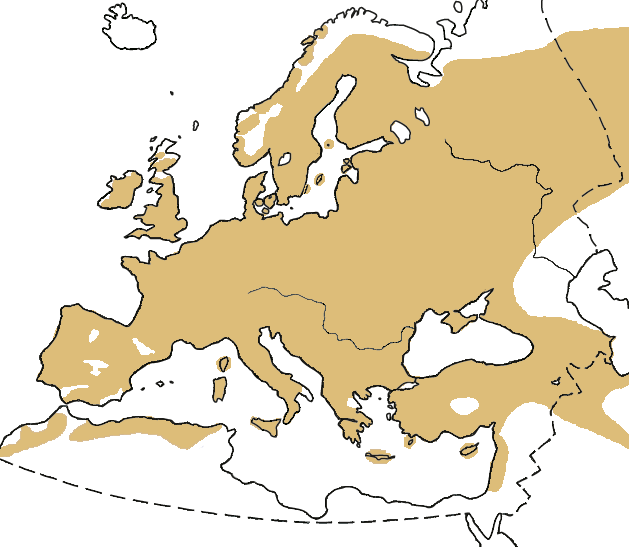 |