
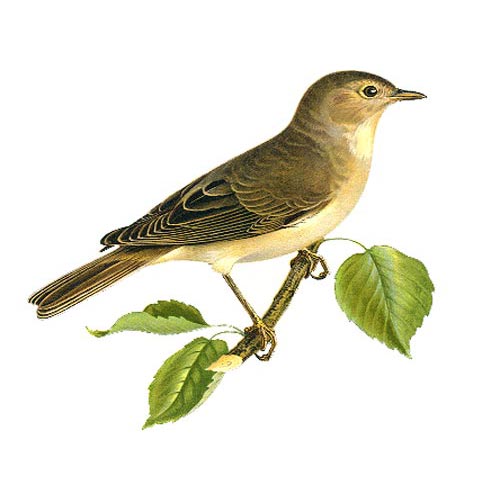
Garden Warbler
€0
The male garden warbler reaches its breeding territory in the beginning of May and will make a number of nests in the bushes.
- Free delivery for purchases over 60€ with DHL Parcel Connect
- Delivery within 3-5 working days
- 14 day return policy
- Customer services open weekdays 8:30-17:00 | +46 (0)431 76800 | info@wildlifegarden.se
- 20 years' expertise in designing, producing and delivering artisanal homeware.
- Maximum age:14 years
- Eggs and clutches:Incubation 12 - 14 days. 4 -5 eggs, often two clutches.
- Latin name:Sylvia borin
Description
The male garden warbler reaches its breeding territory at the beginning of May and will make several nests in the bushes. Only one of these is later chosen to be the actual nest, which is finished off in the mornings when the grass is still damp and easy to mould after the night's dew. The nests are often found in raspberry bushes, but the species also like juniper bushes. As the name suggests, the garden warbler has a beautiful song that usually reminds one of running water.
Appearance
Even in its colour, it is hard to distinguish from other singers. The song is the best way to identify it.Similar bird
It looks somewhat like the grey blackcap, but the latter has either a black or a reddish-brown cap.Sounds and song
It has a rapid and melodious song, which usually lacks flirty notes and may be perceived as an evenly rippling babble.| Song | Warning Call |
Food and bird tables
Feeds mainly on insects. Prefers butterfly larvae and spiders but will resort to berries in the late summer.The nest and hollows
The nest is often placed close to the ground in a shrub.Distribution
 Summer Summer Resident Resident Winter Winter | 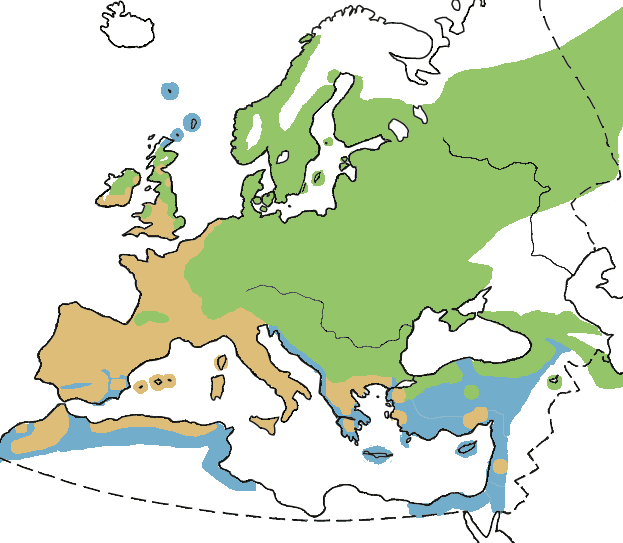 |