
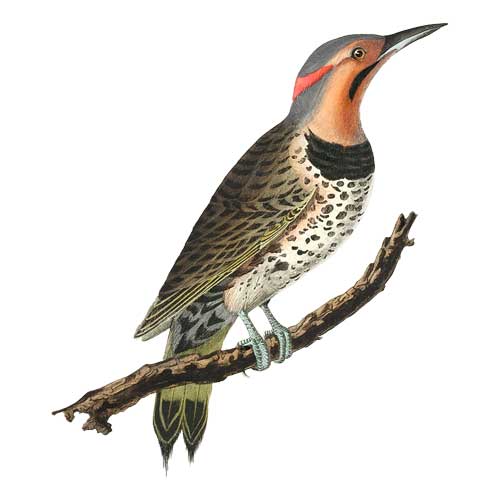
Northern Flicker
- Free delivery for purchases over 60€ with DHL Parcel Connect
- Delivery within 3-5 working days
- 14 day return policy
- Customer services open weekdays 8:30-17:00 | +46 (0)431 76800 | info@wildlifegarden.se
- 20 years' expertise in designing, producing and delivering artisanal homeware.
- PopulationAbout 12 million. The population has been declining for several years, but is not considered endangered.
- Maximum age:9 years
- Eggs and clutches:5–8 eggs in 1–2 clutches.
- Latin name:Colaptes auratus
Description
Description
If you see a large, black-spotted woodpecker looking for food on the ground instead of up in the trees, it's probably a northern flicker – it doesn't behave like other woodpeckers.
Appearance
Large among the American woodpeckers, about 30 centimetres. Strikingly marked with black stripes on the abdomen and back, the ground colour being golden brown. It has a crescent-shaped black bib and a grey or brown head. The white patch on top of the tail is a good distinguishing feature.
Similar birds
There is an eastern variant where the underside of the wing glows yellow, while the western one is orange-red.
Sounds and songs
A long, laughing "ka-ka-ka-ka". Like many woodpeckers, it likes to drum on metallic objects to mark territory.
Diet
The northern flicker finds its food from insects and beetles on the ground. With its long tongue, it sucks in ants. It also eats berries and seeds but is reluctant to visit feeding grounds.
Nest
The northern flicker pecks out its deep nest hole in decaying deciduous trees, often aspen. It may also nest in burrows of suitable appearance.
Distribution
All of North America, parts of Canada and northern Mexico.
 Summer Summer Resident Resident Winter Winter | 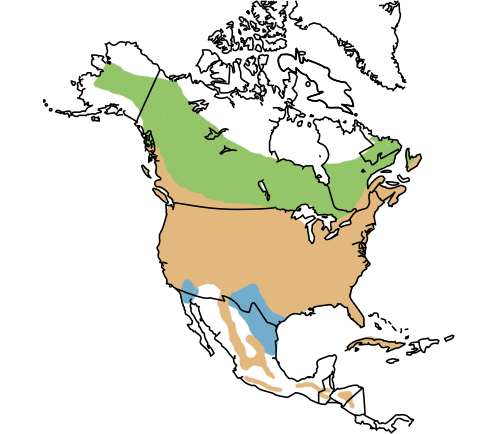 |