

Raven
€0
Our most mythical bird, which we encounter in folklore and in the Icelandic fairy tales. Ravens are considered intelligent birds and their problem-solving skills have many times surprised scientists.
- Free delivery for purchases over 60€ with DHL Parcel Connect
- Delivery within 3-5 working days
- 14 day return policy
- Customer services open weekdays 8:30-17:00 | +46 (0)431 76800 | info@wildlifegarden.se
- 20 years' expertise in designing, producing and delivering artisanal homeware.
- PopulationThe raven is not considered endangered, with about 2 million pairs in Europe.
- Maximum age:Up to 44 years recorded in captivity, but usually 10-15 years.
- Eggs and clutches:4-6 eggs are laid in early spring and incubate for about three weeks.
- Latin name:Corvus corax
Description
Our most mythical bird, which we encounter in folklore and in the Icelandic fairy tales. Ravens are considered intelligent birds and their problem-solving skills have many times surprised scientists.
Appearance
The largest crow with a wingspan of up to 150 cm. All black, with feathers that shine in blue or green. Powerful beak. It prefers to fly at high altitude, with calm wingbeats, but during the mating season it is often seen performing acrobatic feats in the air.Similar birds
The raven can be confused with broad-winged birds of prey, but is larger than the buzzard.Sounds and song
The raven has many calls, but most often you can hear the deep, rasping call that is repeated 3-4 times.| Song |
Food and bird tables
Will visit the bird table occasionally. Insect- and spider eater. Prefers a diet of seeds, preferably beech acorns but also sunflower seeds. Will also eat insects and their larvae, especially in its early years as it is fed by its parents.Nest
The raven is omnivorous—carcasses, live small animals and seeds and fruits are included in its diet.Distribution
The raven breeds throughout Europe down to northern Africa. Outside Europe, it is found in parts of North America and Asia.
 Summer Summer Resident Resident Winter Winter | 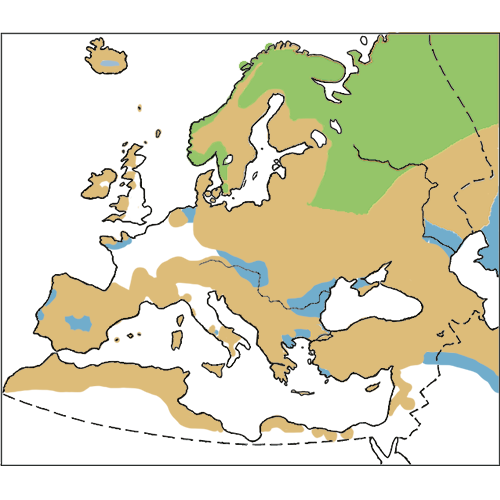 |