
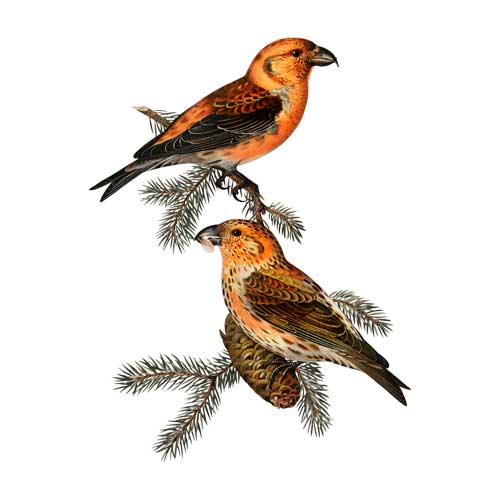
Red Crossbill
- Free delivery for purchases over 60€ with DHL Parcel Connect
- Delivery within 3-5 working days
- 14 day return policy
- Customer services open weekdays 8:30-17:00 | +46 (0)431 76800 | info@wildlifegarden.se
- 20 years' expertise in designing, producing and delivering artisanal homeware.
- PopulationA rough estimate is between 90 and 170 million individuals worldwide. It is not considered threatened, but numbers vary greatly depending on food availability.
- Maximum age:8 years
- Eggs and clutches:2–6 ägg i flera kullar. Under år med god frötillgång kan mindre korsnäbb få ut ungar året runt.
- Latin name:Loxia curvirostra
Description
Description:
The red crossbill is a powerful finch with a special beak where the tips cross. You can expect to see crossbills on the tops of coniferous trees, and they often reveal their presence by dropping pieces of cones to the ground.
Appearance:
15-17 centimetres long, with a compact body, strong neck, and short tail. The male is brick red with brown wings, and the female is yellow-green.
Similar bird:
A closely related species, the Parrot Crossbill, is similar to the Red Crossbill. However, the beak of the greater crossbill is even thicker and longer in height than in length, but this is a detail that even experts can get wrong. The banded crossbill and pine grosbeak are two northern species with similar beaks and colours but white wing bands.
Sounds and songs:
Repeated chirp-chirp-chirp with a metallic sound.
Diet:
The primary food source is spruce seeds and young shoots, supplemented by pine seeds, rowan berries, and insects.
Nest:
The nest is well protected in a coniferous tree, which is lined with moss and lichens.
Geographic range:
The red crossbill is found in coniferous forest areas throughout Europe but is most common in Scandinavia and Russia. It also occurs in much of North America and Canada. The Red Crossbill migrates in large flocks in some years, and its call is clearly heard.
 Summer Summer Resident Resident Winter Winter | 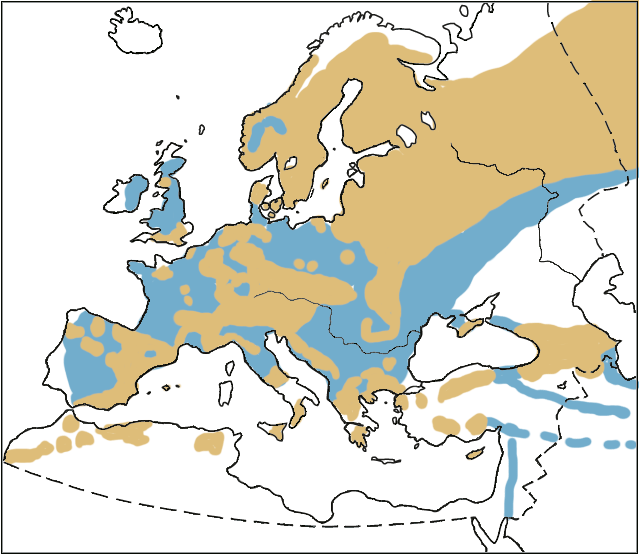 |