
Tree Sparrow
€0
The tree sparrow is present all over Europe and can also be found in Asia, Australia and America.
- Free delivery for purchases over 60€ with DHL Parcel Connect
- Delivery within 3-5 working days
- 14 day return policy
- Customer services open weekdays 8:30-17:00 | +46 (0)431 76800 | info@wildlifegarden.se
- 20 years' expertise in designing, producing and delivering artisanal homeware.
- Maximum age:13 years
- Eggs and clutches:Incubation 12 - 14 days. 5 - 7 eggs, two clutches.
- Latin name:Passer montanus
Description
The tree sparrow is present all over Europe and can also be found in Asia, Australia and America. It often adjusts to live close to humans for example in cities. The tree sparrow eat seeds and corns in the winter and often come to bird tables. In the summer, when it has chicks it eats a lot of insects and larvae. When there is not enough waste seed out in the fields, both the house and the tree sparrow become more dependent on the bird tables to survive the winters.
Spends the greater part of the season eating seeds from weeds. Frequents the bird tables where it eats sunflower seeds and hemp seeds.
The nest is built by both males and females, usually under roof tiles, in holes in brick walls or in nesting boxes.
Back to bird school
Appearance
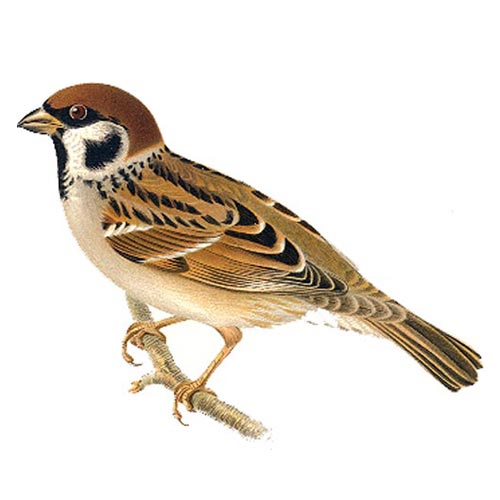
Smaller and more compact than its relative, the house sparrow. A chocolate brown crown, light around the throat and a black spot on the cheek are distinguishing marks. The neat coat is also present with the female and the young birds, which is not the case with the house sparrow.Similar bird
The male house sparrow has a grey section on its crown and no black spot on its cheek.Sounds and song
The call is hard and metallic, and the song is light and usually heard in the spring.| Contact Call |
Food and bird tables
Common guest at bird tables.Spends the greater part of the season eating seeds from weeds. Frequents the bird tables where it eats sunflower seeds and hemp seeds.
The nest and hollows
Will settle in hollows.The nest is built by both males and females, usually under roof tiles, in holes in brick walls or in nesting boxes.
Distribution
 Summer Summer Resident Resident Winter Winter | 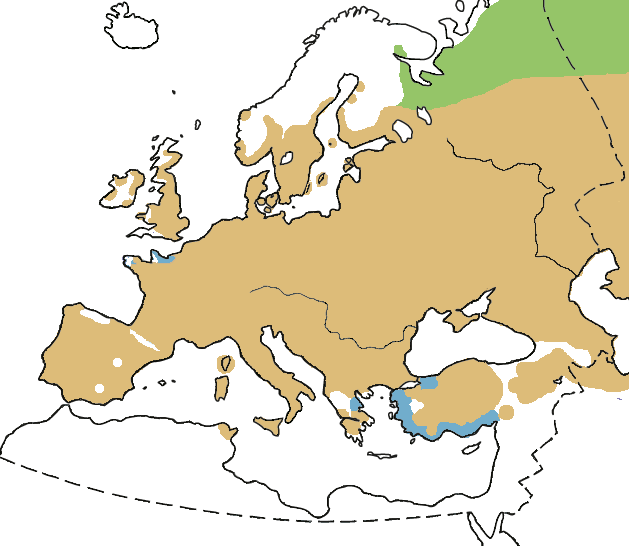 |
Back to bird school