
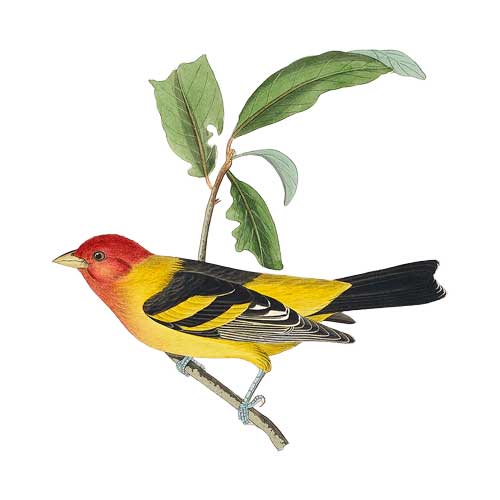
Western tanager
- Free delivery for purchases over 60€ with DHL Parcel Connect
- Delivery within 3-5 working days
- 14 day return policy
- Customer services open weekdays 8:30-17:00 | +46 (0)431 76800 | info@wildlifegarden.se
- 20 years' expertise in designing, producing and delivering artisanal homeware.
- PopulationThe Western tanager has an extensive geographical range. The population, estimated to be around 15 million individuals, is increasing.
- Maximum age:Up to 7 years.
- Eggs and clutches:3–5 eggs.
- Latin name:Piranga ludoviciana
Description
Description
The western tanager is a typical summer visitor to the western United States and Canadian forests. The male's orange-red head shines high in the canopy. Although not typically flock birds, they can be seen in large numbers in parks and gardens during the spring and autumn migration period.
Appearance
The orange-red head on the male transitions into a yellow body with sooty-grey wings and two bright wing bands. Apart from the red head, the females share similar colouring. At 17–19 centimetres, it is slightly smaller than a starling.
Similar birds
Within its range, the western tanager is quite distinct from other birds. However, the female can be confused with females of related species found further south.
Sounds and songs
Their song consists of short calls in 4–6 repeated bursts.
Diet
It feeds mainly on insects such as ants, wasps, locusts and termites but can supplement its diet with fruit and berries.
Nest
The female weaves small branches to construct a nest floor and then builds the walls. Finally, she lines the nest with grass, moss, and hair.
Geographic range
The western tanager nests in the western parts of the United States and Canada but migrates south to Central America in winter.
 Summer Summer Resident Resident Winter Winter | 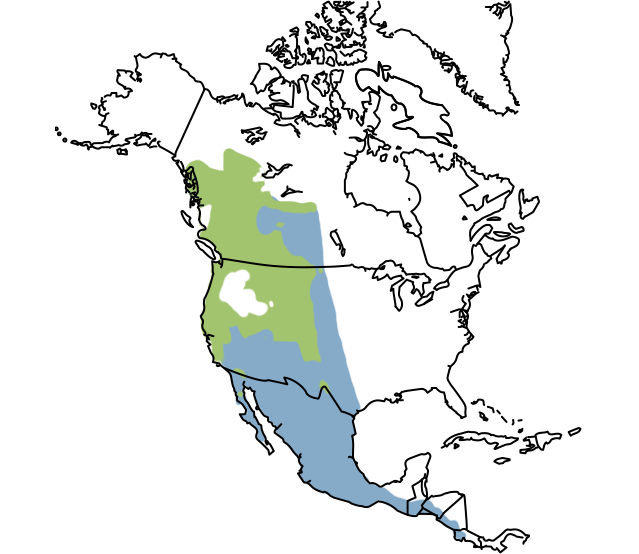 |