
Wren
€0
The Eurasian wren’s scientific family name comes from the Greek and means ”the one who dwells in caves”.
- Free delivery for purchases over 60€ with DHL Parcel Connect
- Delivery within 3-5 working days
- 14 day return policy
- Customer services open weekdays 8:30-17:00 | +46 (0)431 76800 | info@wildlifegarden.se
- 20 years' expertise in designing, producing and delivering artisanal homeware.
- Maximum age:8 years
- Eggs and clutches:Incubation 14 - 15 days. 6 - 8 eggs, two clutches per season.
- Latin name:Troglodytes troglodytes
Description
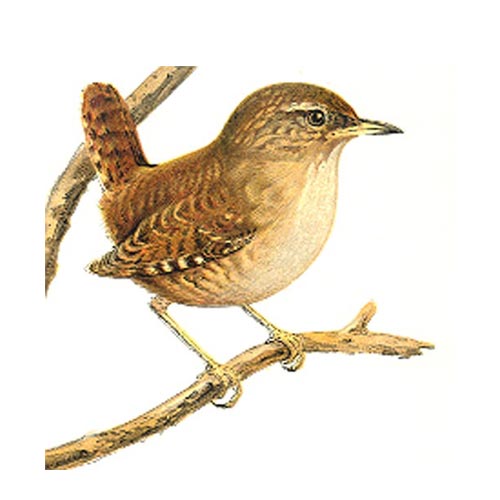
The wren’s scientific family name comes from the Greek and means” the one who dwells in caves”. According to Swedish folklore, the wren is a chubby little fellow with a big head who runs like a little mouse on heaps of brushwood and turned-up roots, always with the little tail pointing proudly straight up.
Lives off insects and berries in the autumn and off meat in the winter.
Appearance
The wren has a long, thin beak that is slightly compressed, with narrow nostrils covered by an arched membrane. Short, cupped and rounded wings and a short, rounded tail which stands upright. The legs, on the other hand, are long. The back of the bird is a dark reddish brown with thin, blackish crosswise lines; these are also found on the belly. The abdomen is rusty brown with black crosswise lines. There is a whitish line over the eye; the throat and the breast are white with a small hint of blue.Similar bird
Due to its small stature and brown colouration, it is difficult to mistake it for anything else. The treecreeper has an oblong form and different behaviour.Sounds and song
The call is a dry rattle that can turn into a clicking sound when irritated. The song is fast and bouncy, with clear tones and humming warbles.| Song |
Food and bird tables
Rarely seen at the bird table.Lives off insects and berries in the autumn and off meat in the winter.
The nest and hollows
The nests consist of moss, are lined with feathers, and are placed in sprig shrubs, turned-up roots, or juniper shrubs. The male builds several nests to stay the night in – ingenious constructions, large and spherically shaped.Distribution
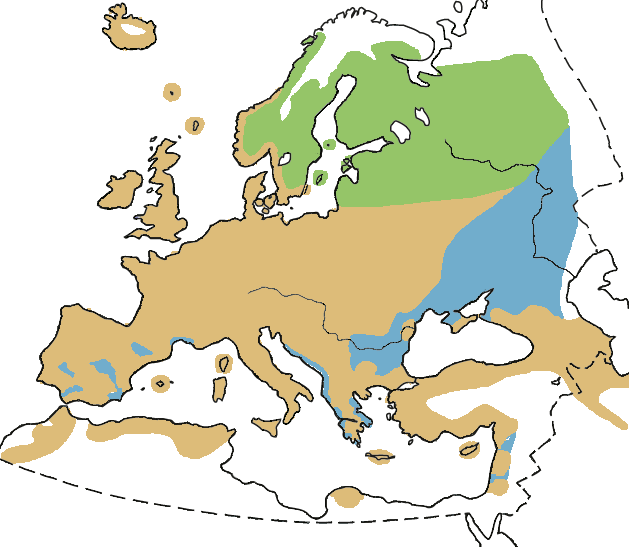
 Summer Summer Resident Resident Winter Winter |
 |