
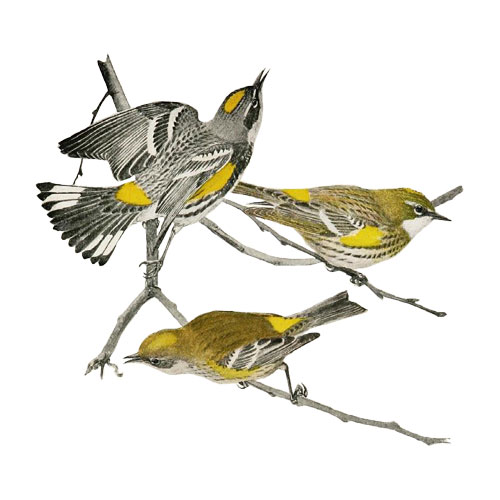
Yellow-rumped Warbler
- Free delivery for purchases over 60€ with DHL Parcel Connect
- Delivery within 3-5 working days
- 14 day return policy
- Customer services open weekdays 8:30-17:00 | +46 (0)431 76800 | info@wildlifegarden.se
- 20 years' expertise in designing, producing and delivering artisanal homeware.
- Population170 million
- Maximum age:10 years noted, but usually 4–5 years.
- Eggs and clutches:1–5 in 1–2 clutches.
- Latin name:Setophaga coronata
Description
Description
This warbler is the most common in North America, and it catches the eye with its yellow spots on the chin, side and tail. It is often seen in small flocks in sparse pine forests.
Appearance
The body is quite solidly built on this warbler, which is about 15 centimetres long, with a long tail. The ground colour is grey or grey-brown with a white wing band. In summer, the male contrasts with black around the eye, a bright yellow bib and yellow spots on the sides. Females are more modestly grey-striped and lighter on the belly.
Similar bird
There are several dozen forest warblers in North America, many with yellow features like this species. But if you see a long-tailed warbler in winter that sits upright and has a yellow patch on its tail, the yellow-rumped warbler is an excellent guess.
Sounds and songs
The song is a rather toneless stanza with short monosyllabic chirps that are repeated.
Food
Insects are the main food, but it is highly adaptable. In winter, it gladly comes to bird feeds and eats sunflower seeds, raisins and tallow balls. Thanks to its ability to receive nutrition from the peel of the berry, it copes well in the cold winters.
Nest
The nest is bowl-shaped and made of grass, bark fibres, feathers and hair. It is placed on a branch of a deciduous or coniferous tree.
Distribution
All of North America, Central America and Canada except the Arctic regions.
 Summer Summer Resident Resident Winter Winter | 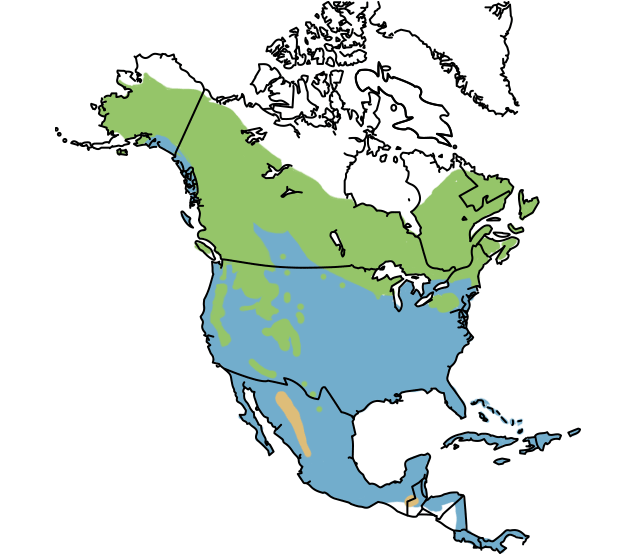 |