

European Peacock
€0
It is no coincidence that the European Peacock’s markings resemble staring eyes.
- Free delivery for purchases over 60€ with DHL Parcel Connect
- Delivery within 3-5 working days
- 14 day return policy
- Customer services open weekdays 8:30-17:00 | +46 (0)431 76800 | info@wildlifegarden.se
- 20 years' expertise in designing, producing and delivering artisanal homeware.
- Latin name:Inachis io
Description
(Inachis io)
Did you know that
It is no coincidence that the European Peacock’s markings resemble staring eyes. When the butterfly opens it swings, it is these staring eyes that scare off predators.
Back to Butterfly School
Did you know that
It is no coincidence that the European Peacock’s markings resemble staring eyes. When the butterfly opens it swings, it is these staring eyes that scare off predators.
Geographical distribution
These butterflies can be found in Europe and Asia.Appearance
The base colour of the wings is a rusty red and there is a distinctive blue eye on each wingtip. The underside of the wings is a dark greyish brown, giving the butterfly perfect camouflage against a branch or tree trunk. The male and female have identical markings.Similar butterflies
The European Peacock can sometimes be mistaken for the Small Tortoiseshell, but the ”eye” is the giveaway sign that it is a European Peacock.Life cycle
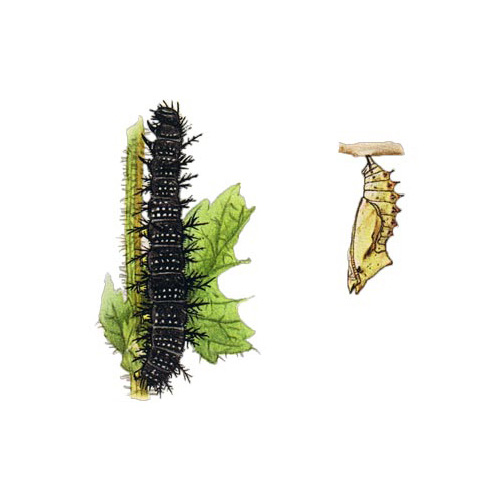
European Peacocks overwinter as adult butterflies. They come back to life in April and fly until the end of June. During this period, the first generation lays its eggs on nettles, finally hatching as adult butterflies in July. The second generation of butterflies spend the winter in holes and gaps in trees, old houses or butterfly boxes.Back to Butterfly School