
Swallowtail
€0
Old World Swallowtails are excellent gliders and rarely use their wings to fly.
- Free delivery for purchases over 60€ with DHL Parcel Connect
- Delivery within 3-5 working days
- 14 day return policy
- Customer services open weekdays 8:30-17:00 | +46 (0)431 76800 | info@wildlifegarden.se
- 20 years' expertise in designing, producing and delivering artisanal homeware.
- Latin name:Papilio machaon
Description
(Papilio machaon)
Did you know that
Old World Swallowtails are excellent gliders and rarely use their wings to fly. When they sip nectar from flowers, however, they are forced to flap their wings so as not to weigh down the flowers with their heavy bodies.
Back to Butterfly School
Did you know that
Old World Swallowtails are excellent gliders and rarely use their wings to fly. When they sip nectar from flowers, however, they are forced to flap their wings so as not to weigh down the flowers with their heavy bodies.
Geographical distribution
This species is extremely good at adapting to its surroundings. They cope with both the heat of North Africa and the cold of Scandinavia and Canada. Old World Swallowtails can be seen all across Europe, in the warmer parts of Asia, North Africa and North America. They are, however, suffering a decline here in Scandinavia now that damp mossland and meadows are disappearing.Appearance
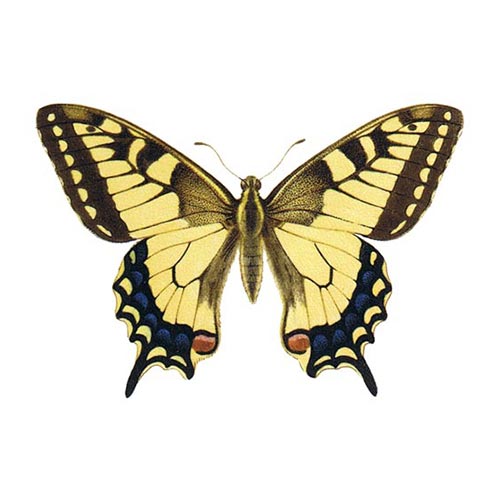
The Old World Swallowtail has the most tropical appearance of our Scandinavian butterflies. The wings have a yellow base with regular black markings. The forewings are curved and the hind wings have a protruding tail. Males and females have a similar appearance, but the females are usually slightly bigger. With a wingspan of up to 10 cm, the Old World Swallowtail is a beautiful guest in the garden!Life cycle
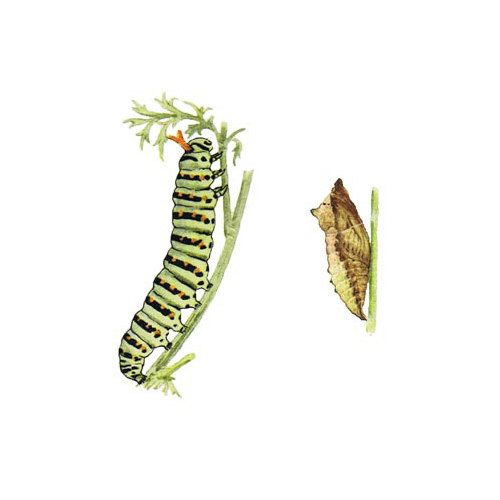
When mating, the male and female are often attached for several hours. The eggs are hatched after just one week and when the larvae are born they are a greyish-black at first and then turn bright green with black stripes and orange spots. They have an ingenious defence system; they have projections behind their heads that can release a foul smell in order to deter predators. The Old World Swallowtail flies for two generations and overwinters as pupa.Back to Butterfly School