
Blackbird
- Free delivery for purchases over 60€ with DHL Parcel Connect
- Delivery within 3-5 working days
- 14 day return policy
- Customer services open weekdays 8:30-17:00 | +46 (0)431 76800 | info@wildlifegarden.se
- 20 years' expertise in designing, producing and delivering artisanal homeware.
- Maximum age:21 years
- Eggs and clutches:Incubation 13 - 14 dagar. 4 - 6 eggs. Often two clutches.
- Latin name:Turdus merula
Description
Appearance
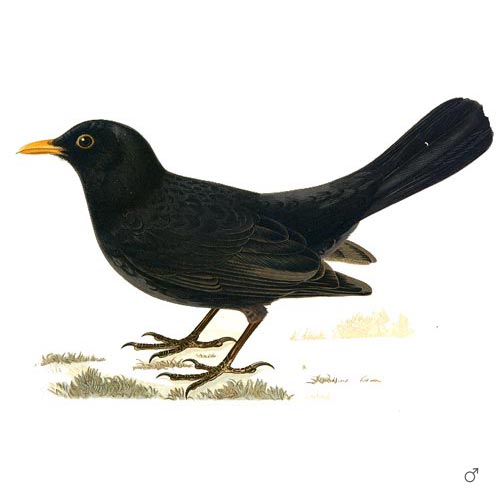
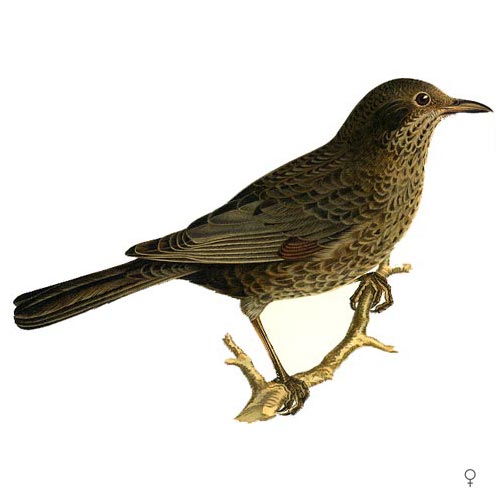
A sturdy and long-tailed thrush. The adult male is easy to recognise as it is completely black, with a yellow beak and yellow rings at the eyes. The female, however, is dark brown with a lighter throat and brown rings at the eyes. When the blackbird moves along the ground, it jumps with both feet together.
Similar bird
May be confused with a starling. However, the starling has a short tail and walks rapidly and jerkily.Sounds and song
Makes and imitates many different sounds, including tits, goldfinches, black woodpeckers, and greenfinches. Some blackbirds will even imitate sounds with some connection to humans.
| Song |
Food and bird tables
Common guest at the bird table.
Will eat primarily worms and insects in the summer, as well as mushrooms, berries and fruit in the autumn. The blackbird prefers to sit on the ground but will attempt to mount the bird table when the ground is covered in snow in order to eat fruit or dried berries.
The nest and hollows
Breeds in all of the UK. As long as there is some kind of vegetation and, preferably, human settlement. The nest, which consists of blades, moss and leaves, is mixed with soil and is usually placed at low heights in the thick branches of trees.
Distribution
 Summer Summer Resident Resident Winter Winter | 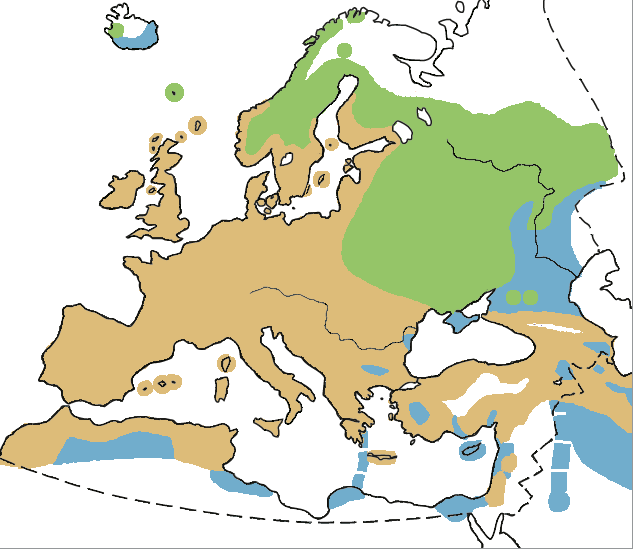 |