

Pied Flycatcher
€0
The pied flycatcher is mainly found in the west of the UK and not at all in the North of Ireland.
- Free delivery for purchases over 60€ with DHL Parcel Connect
- Delivery within 3-5 working days
- 14 day return policy
- Customer services open weekdays 8:30-17:00 | +46 (0)431 76800 | info@wildlifegarden.se
- 20 years' expertise in designing, producing and delivering artisanal homeware.
- Maximum age:11 years
- Eggs and clutches:Incubation two weeks. 6 -7 eggs
- Latin name:Ficedula hypoleuca
Description
The pied flycatcher is mainly found in the west of the UK and not in the North of Ireland. The collared flycatcher is instantly recognizable due to its white collar. The males will arrive in the UK at the beginning of April, while the females arrive somewhat later.
During the breeding season, the biggest concern is finding appropriate nesting spots. As soon as the males arrive, an intensive search for hollows begins, around which the territories are established. However, the hunt isn't over, even as the males have marked their territories and mated with a female.
When the female has laid her eggs, the male leaves her to establish a secondary territory. The competition among the males for the females is, however, stiff, and once the secondary territories have been established, the access to females who have not yet mated is minimal. Sometimes, the males succeed in this endeavour, but once he has mated with the new female in the secondary territory and she has started laying eggs, he will usually leave her to return to the first female.
Appearance
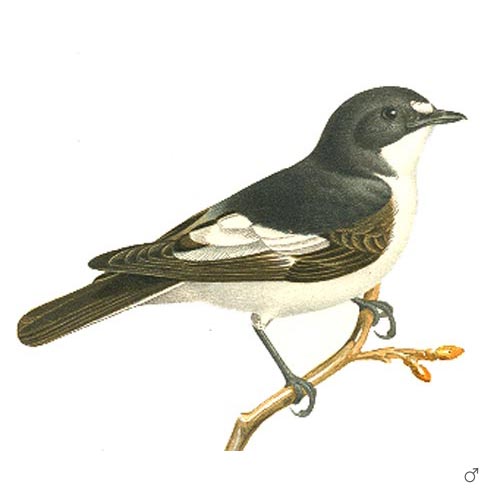
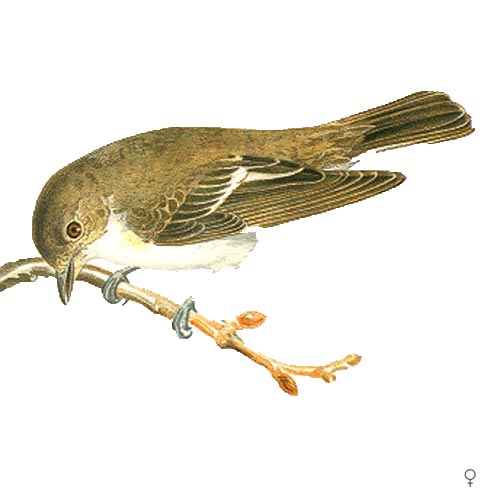
Plumage with contrasting colours of black and white. On the wings, it has a wide area of white, but otherwise, it is black on its back and head, including the cheeks. Greyish-white underneath. The female is a brown image of the male.Similar bird
The spotted flycatcher has grey lines across the forehead and no white patch on the wing.Sounds and song
The call is short and soft, which turns more complex and frequent in times of danger, sometimes combined with a clicking. The song is crisp and clear, varied and rhythmic. Short verses are often repeated three times.| Song |
Food and bird tables
Its diet consists of mosquitoes, flies, butterfly larvae and spiders.The nest and hollows
Likes to nest in hollows; it is one of the most frequent guests in nesting boxes. If there is a nesting box in the neighbourhood, the pied flycatcher is bound to be there to see it. It doesn’t matter if the great tit has already started to nest there; it will be sent packing. Luring small birds to the garden is straightforward by mounting nesting boxes.Distribution
Back to bird school Summer  Resident  Winter | 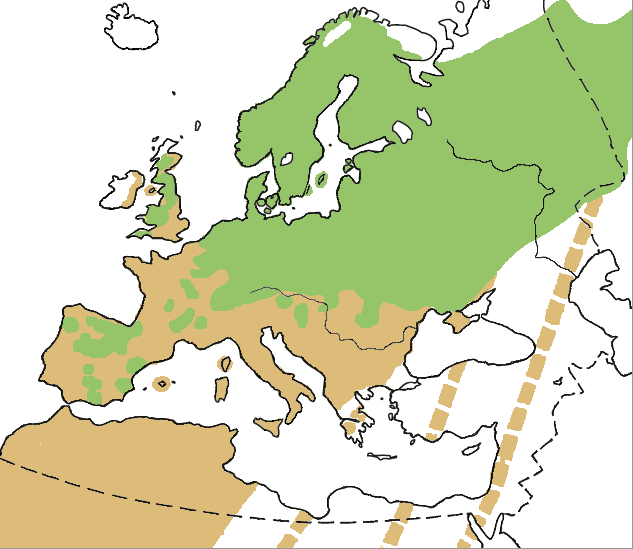 |