
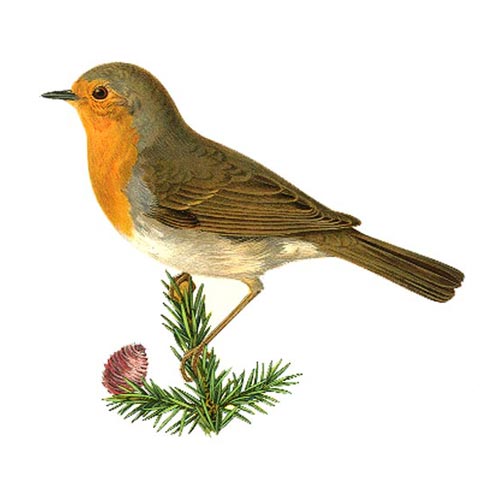
Robin
€0
The robin is an extraordinary bird, partly because of its appearance.
- Free delivery for purchases over 60€ with DHL Parcel Connect
- Delivery within 3-5 working days
- 14 day return policy
- Customer services open weekdays 8:30-17:00 | +46 (0)431 76800 | info@wildlifegarden.se
- 20 years' expertise in designing, producing and delivering artisanal homeware.
- Maximum age:The robin can become as old 17 years, but 90% of the young birds die by their first year.
- Eggs and clutches:The bird usually raises two broods each year. Building the nest takes 4 days, laying the eggs 5 days, brooding 13 days and then another 14 days before the hatchlings leave the nest. The 6 - 8 eggs are a yellowish white with yellow-brown spots, usually situated at the wide end of the egg
- Latin name:Erithacus rubecula
Description
The robin is an extraordinary bird, partly because of its appearance, its red breast, the dark peppercorn eye and the dapper body, and partly because of its behaviour, its tendency to suddenly appear from the shadow of a bush or jump across the lawn with its feet together like a little mechanical toy. The red breast plays an important part when it marks its territory. ”One bush can never house more than one robin” is what Zenodotos wrote even before our era. The average age is surprisingly low, barely one year.
The robin feeds on insects and insect larvae. Most insect eaters leave the country in the winter, but the robin is the exception, along with the winter wren and the tree creeper. Looking at their beaks, you will understand why they cannot crack sunflower seeds or bite through hard fruits. Their beaks are instead formed to extract insects from their hideouts. Many of these birds die during long and snowy winters before the spring sun is out again.
He will come to the bird table in winter if you offer him the right food. If you wish to feed the robin with high-energy food in the winter, mealworm is the best suited, but crushed seeds also work.
The traditional bird feeders and dispensers birds visit aren’t always appropriate for birds who usually sit on the ground and need a plane surface.
Appearance
The rusty red breast on the otherwise grey bird makes him easy to recognise, as well as the slightly drooping wings and the short tail. The long legs and the beady eyes are also marked features.Similar bird
They are sometimes mistaken for the greyish-brown winter wren, possibly because of their slight stature. On the other hand, the winter wren has an upright short tail, making it instantly recognisable.Sounds and song
It is mainly active at dusk and will snap as if winding up clockwork. The robin’s song begins with a few high, drawn-out delicate notes followed by another drawn-out, trembling and rippling silvery notes which die down after a little while.| Song | Contact Call |
| Warning Sound |
Food and bird tables
Will visit the table from time to time.The robin feeds on insects and insect larvae. Most insect eaters leave the country in the winter, but the robin is the exception, along with the winter wren and the tree creeper. Looking at their beaks, you will understand why they cannot crack sunflower seeds or bite through hard fruits. Their beaks are instead formed to extract insects from their hideouts. Many of these birds die during long and snowy winters before the spring sun is out again.
He will come to the bird table in winter if you offer him the right food. If you wish to feed the robin with high-energy food in the winter, mealworm is the best suited, but crushed seeds also work.
The traditional bird feeders and dispensers birds visit aren’t always appropriate for birds who usually sit on the ground and need a plane surface.
The nest and hollows
They will nest in hollows, particularly in years when there are plenty of voles. The nest is built in hollow tree stumps, in between tree roots and in cracks in denser thickets. It consists of moss and is lined with fine roots and blades of grass. The robin may move into a nesting box for specific years, provided it has the right design with a balcony opening. The size of their territories depends on the vegetation, but an area of 1000 square metres usually won’t house more than one or two pairs. In this narrow area, the child has to find food and raise their family.Distribution
 Summer Summer Resident Resident Winter Winter | 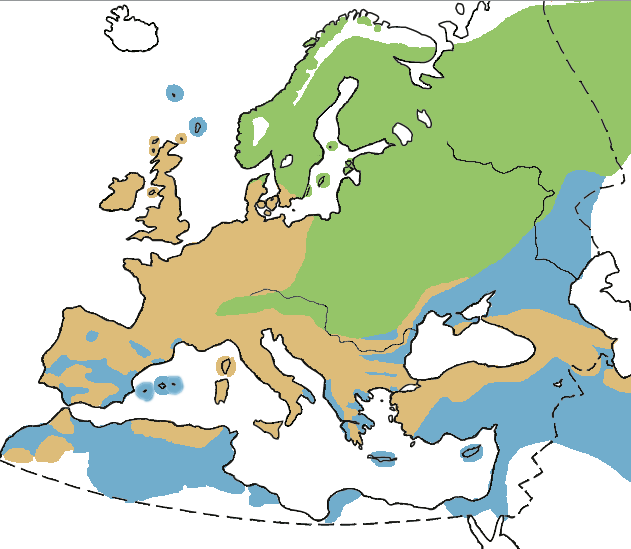 |